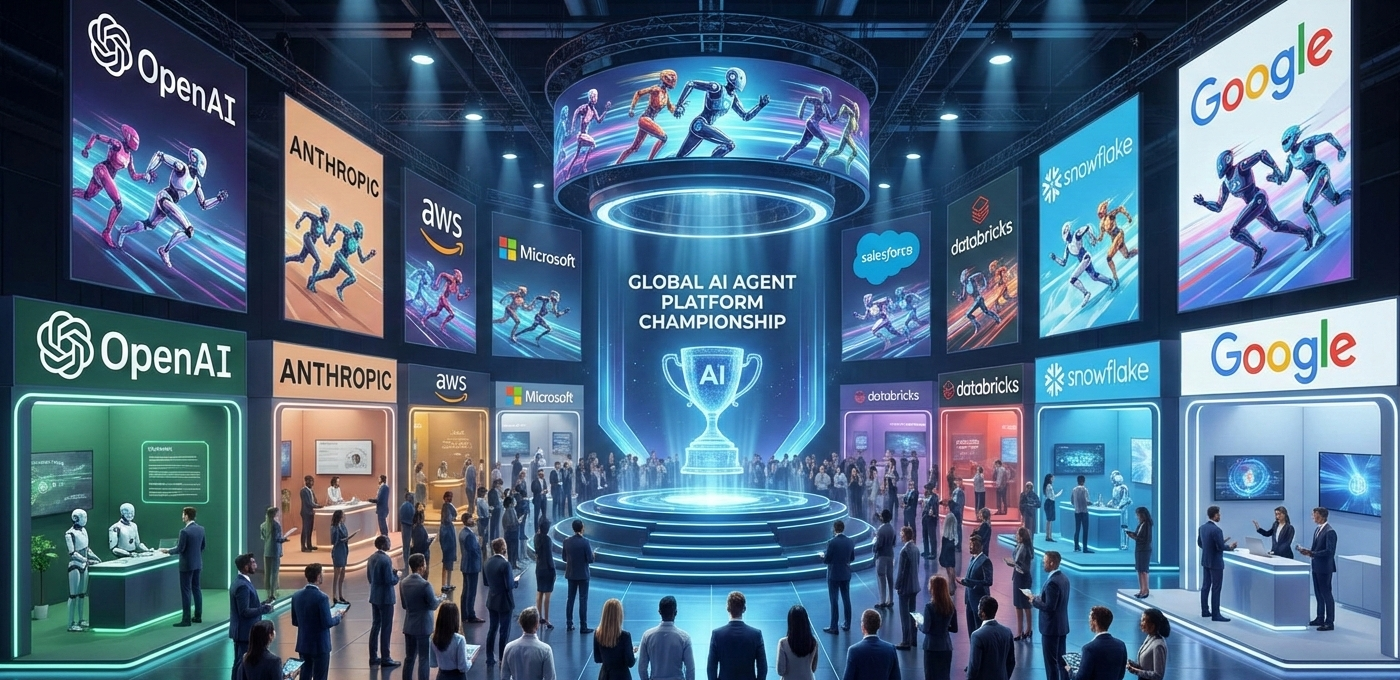
In six weeks, we've seen OpenAI launch Frontier, Anthropic release Cowork to Windows, Snowflake seal a $200 million OpenAI partnership, and Salesforce rebrand its entire platform around Agentforce 360. AWS continues expanding Bedrock AgentCore after its general availability last fall. Microsoft keeps pushing Copilot deeper into the enterprise. Databricks is advancing Mosaic AI agents. Google is building out Vertex AI.
Somewhere in all this, you're supposed to make a decision about where to invest.
The marketing claims blur together. The feature comparisons multiply. And the fundamental question remains: which of these actually solves your problem?
Here's our read on what each major platform actually does and who it's for.
In This Post
- The Landscape
- OpenAI Frontier
- Claude Cowork
- AWS Bedrock AgentCore
- Salesforce Agentforce
- Microsoft Copilot
- Databricks Mosaic AI
- Snowflake Cortex AI
- Google Vertex AI
- What We Don't Know Yet
- The Decision That Matters
The Landscape
These platforms aren't all solving the same problem. They occupy different positions in the stack.
Enterprise orchestration platforms like OpenAI Frontier manage fleets of AI agents across an organization's systems. They provide shared business context, identity management, and governance at scale.
Desktop productivity agents like Claude Cowork operate at the individual or team level, automating tasks on a user's machine without requiring enterprise infrastructure.
Application-embedded agents like Salesforce Agentforce and Microsoft Copilot live inside existing software ecosystems, optimized for specific workflows.
Data platform agents like Databricks Mosaic AI and Snowflake Cortex AI build on existing data infrastructure, extending analytics and ML platforms into agentic territory.
Build-your-own platforms like AWS Bedrock AgentCore provide infrastructure to construct custom agents using any framework and model.
OpenAI Frontier
Launched February 5, 2026. OpenAI is positioning this as "the operating system of the enterprise" for AI agents.
Frontier connects data warehouses, CRM, ticketing tools, and internal applications to create a semantic layer that agents can access. Each agent gets a defined identity with explicit permissions. Built-in audit trails and optimization loops.
Initial customers include Uber, State Farm, Intuit, and Thermo Fisher Scientific. Case studies claim a semiconductor manufacturer reduced production optimization from six weeks to one day.
The platform works with agents from OpenAI, Google, Microsoft, and Anthropic. This openness is strategic: if OpenAI owns the orchestration layer, they win regardless of which models power individual agents.
Claude Cowork
Anthropic's desktop agent, now available on Windows as of this week. Unlike Frontier's enterprise scope, Cowork operates at the desktop level.
Point it at a folder and describe what you want done. Claude reads files, creates or edits new ones, and works through multi-step plans. The plugin system (launched January 30) adds domain-specific capabilities for sales, legal, finance, and other functions.
Available to Claude Pro subscribers at $20/month, with additional tiers at $100 and $200/month. The low barrier makes it accessible for experimentation.
Cowork triggered a $285 billion selloff in software stocks when it launched, reflecting investor concern about AI agents displacing enterprise software categories.
AWS Bedrock AgentCore
Generally available since October 2025, AgentCore is for organizations that want control over their agent infrastructure. This isn't a pre-built agent platform; it's a set of services for building, deploying, and operating agents using any framework and model.
AgentCore provides Runtime for serverless deployment, Gateway for tool access (including MCP support), Memory for context retention, Identity for authentication, and Observability for monitoring. Everything works together or independently.
Robinhood scaled from 500 million to 5 billion tokens daily while reducing AI costs by 80%. Ericsson uses AgentCore across their telecom systems spanning millions of lines of code.
Pay-as-you-go based on compute and API calls. No licensing fees for AgentCore services themselves.
Salesforce Agentforce
Salesforce has rebranded its entire platform around Agentforce 360, positioning it as the agent layer for customer-facing operations.
Role-specific agents (Sales Coach, Service Agent, Personal Shopper) are pre-configured for common use cases. Agent Builder provides low-code customization using Flows, Prompts, Apex, and MuleSoft APIs.
The differentiation from Einstein Copilot: Agentforce is designed for autonomous action, not just assistance. Agents can execute multi-step workflows without human intervention.
MuleSoft Agent Fabric provides connectors to discover and govern agents across Salesforce, Amazon Bedrock, Google Vertex AI, and Microsoft Copilot Studio, positioning Salesforce as a potential orchestration layer for multi-vendor deployments.
Microsoft Copilot
Microsoft's approach is embedded: Copilot capabilities are woven throughout Microsoft 365, Dynamics 365, and the Power Platform.
Copilot provides AI assistance within Word, Excel, PowerPoint, Outlook, and Teams. Copilot Studio allows building custom agents with low-code tools. Microsoft Graph provides contextual enterprise data.
The interesting wrinkle: Microsoft has invested in Anthropic and is encouraging thousands of employees to use Claude Code and Cowork, even teams with no coding experience. This dual-vendor approach suggests Microsoft sees AI agents as too important to depend on any single provider.
Copilot for Microsoft 365 runs $30/user/month. For organizations already on E3 or E5, the incremental cost drives adoption even when productivity gains are modest.
Databricks Mosaic AI
For organizations already running analytics and ML workloads on Databricks, Mosaic AI offers agents without leaving the platform.
Agent Framework provides tools for building, deploying, and evaluating agents with access to Unity Catalog data, Vector Search for unstructured retrieval, and MCP server connections. Agent Evaluation measures quality using AI judges and human feedback. Built-in governance, guardrails, and observability.
Block built AI agents to automate seller operations. Intercontinental Exchange created agents using proprietary financial data to answer customer questions. Comcast built personalized viewer experiences with intelligent voice commands.
DBU-based pricing. AI workloads generally start at $0.07 per DBU for foundation model serving.
Snowflake Cortex AI
Snowflake just sealed a $200 million partnership with OpenAI to bring frontier models directly into the platform.
Cortex Agents orchestrate across structured and unstructured data using Cortex Analyst (SQL on structured data) and Cortex Search (unstructured retrieval). The recently announced Cortex Code is an AI coding agent that understands Snowflake's data context for natural language data engineering.
Snowflake Intelligence is the enterprise agent designed to give every employee access to trusted insights through natural language, powered by GPT-5.2.
WHOOP reports 5-10x productivity gains with Cortex Code. Braze, LendingTree, and United Rentals are early adopters.
Credit-based pricing aligned with Snowflake's consumption model.
Google Vertex AI
Agent Builder enables creating agents that combine generative AI with structured data and tools. Integration with Google Workspace provides access to documents, email, and calendar. Grounding with Google Search provides current information.
Like AWS, Google offers components rather than finished products. The integration advantages are most apparent for organizations standardized on GCP and Google Workspace.
What We Don't Know Yet
For all the announcements, there are significant open questions that none of these platforms have fully answered.
Interoperability is unproven. Most of these platforms claim to work with multiple models and frameworks. In practice, the depth of those integrations varies wildly. Whether an agent built on one platform can meaningfully interact with agents on another remains largely theoretical.
Pricing will evolve. Several platforms launched with aggressive pricing or consumption-based models. As usage scales and the competitive landscape stabilizes, expect pricing structures to shift. The economics that make sense at pilot scale may not hold at enterprise scale.
Governance standards don't exist yet. Every platform offers its own approach to agent identity, permissions, and audit trails. There is no industry standard for AI agent governance. Organizations adopting multiple platforms will need to build their own governance layers on top.
The consolidation question. Nine platforms is a lot. History suggests this market will consolidate. Some of these platforms will merge, pivot, or get absorbed. Betting heavily on any single vendor carries risk, but so does spreading too thin.
Agent reliability at scale. Case studies are promising, but most involve controlled environments with well-defined workflows. How these agents perform when handling ambiguous, edge-case-heavy enterprise processes at scale is still an open question.
The Decision That Matters
The platform choice is less important than understanding what category of problem you're solving. Enterprise orchestration, desktop productivity, CRM automation, data platform extension, or custom build: each has different requirements, different economics, and different organizational implications.
Most organizations will end up with multiple approaches. The challenge is coordinating across them without creating governance gaps.
The right answer depends on your existing systems, your engineering capacity, your governance requirements, and your specific use cases.
If you're evaluating these platforms and want a partner who understands both the technology and the practical realities of implementation, we should talk.
Sources
-
OpenAI, "Introducing OpenAI Frontier" (February 5, 2026). openai.com
-
VentureBeat, "Anthropic's Claude Cowork finally lands on Windows" (February 11, 2026). venturebeat.com
-
AWS, "Amazon Bedrock AgentCore is now generally available" (October 13, 2025). aws.amazon.com
-
Salesforce, "Dive into our Agentforce 360 Announcements." salesforce.com
-
The Verge, "Claude Code is suddenly everywhere inside Microsoft." theverge.com
-
Microsoft, "Expanding model choice in Microsoft 365 Copilot" (September 2025). microsoft.com
-
Databricks, "Mosaic AI Announcements at Data + AI Summit 2025." databricks.com
-
OpenAI, "Snowflake and OpenAI partner to bring frontier intelligence to enterprise data" (February 2, 2026). openai.com
-
Google Cloud, "More ways to build and scale AI agents with Vertex AI Agent Builder" (November 2025). cloud.google.com
Semper AI helps organizations evaluate, implement, and govern AI agent platforms. Contact us to discuss how we can help you navigate the agent landscape.