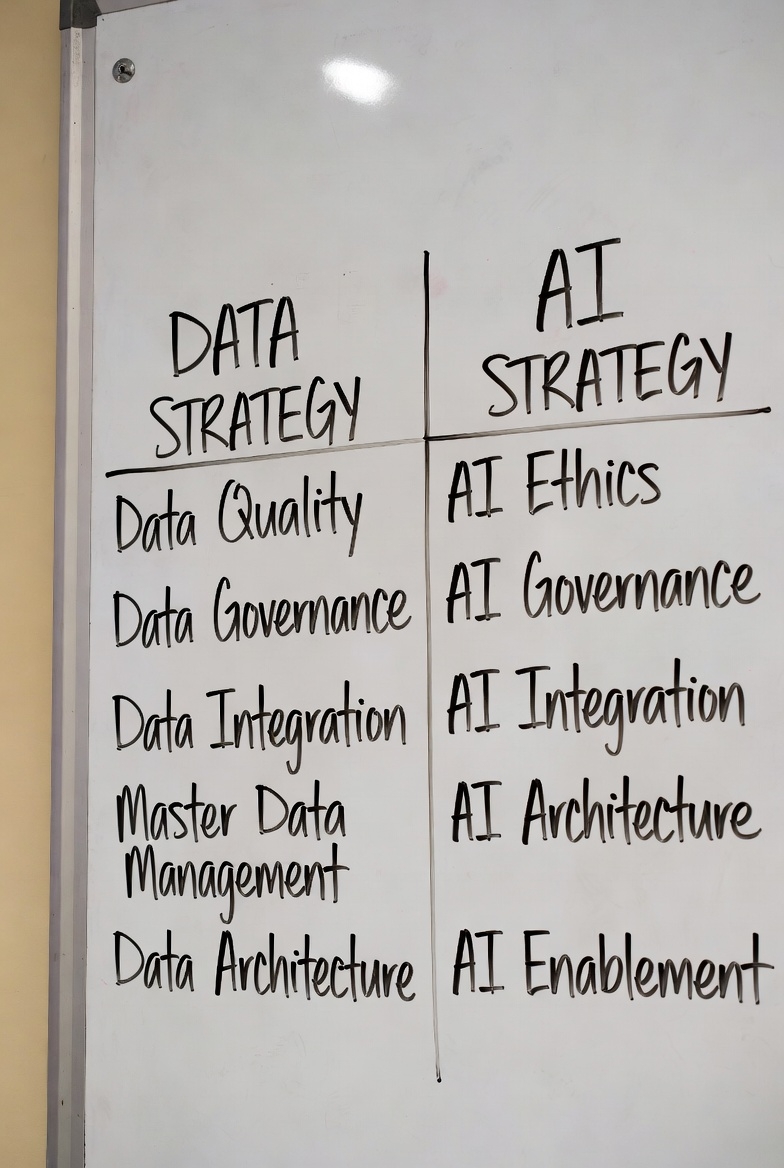
Whether you are a seasoned executive who has navigated multiple technology cycles or a rising leader just beginning to shape your organization's direction, we are all standing together at a threshold. The decisions we make in the months ahead will define not just quarterly results, but the long-term viability of the enterprises we serve.
For years, data strategy has lived in a peculiar gray zone. Organizations acknowledged its importance in boardroom presentations and annual reports, yet treated it as something that could be deferred, delegated, or addressed incrementally. That era is ending, not because of hype or vendor pressure, but because the gap between data-capable organizations and everyone else has grown too wide to ignore.
The Shift We Are Witnessing
The transformation can be understood by examining three dimensions:
-
Competitive. Companies that invested in data infrastructure over the past five years are now operating at speeds and scales their competitors cannot match. They are not just analyzing markets faster: they are creating new markets entirely, using insights their peers cannot access.
-
Operational. Generative AI has moved from experiment to expectation. But here is what many organizations are discovering too late: you cannot deploy AI capabilities on a foundation of fragmented data, inconsistent definitions, and manual pipelines. The organizations succeeding with AI are those who did the unglamorous work of building coherent data ecosystems first.
-
Existential. Regulatory frameworks are tightening. The EU AI Act is now in force. Privacy legislation continues to expand. Organizations without clear data governance are not just inefficient: they are exposed.
The Honest Reality
This transition will not be easy. Many organizations are starting from difficult positions: legacy systems remain entrenched, technical debt has accumulated over decades, talented data professionals are expensive and in short supply, and budgets are constrained.
But I do not view that difficulty so negatively. The organizations that will thrive in 2026 are not necessarily those with the largest budgets or the most sophisticated technology stacks. They are the ones willing to be honest about where they stand, clear about where they need to go, and disciplined about the steps required to get there. Constraint, when met with clarity, becomes a catalyst for focused action.
What Makes This Year Different
Previous years offered the luxury of optionality. You could experiment with data initiatives, launch pilot projects, and defer hard decisions about integration and governance. That optionality has collapsed. Three forces are converging:
-
AI has become operational. Your competitors are deploying it. Your customers are expecting it. Your employees are using it: whether you have sanctioned it or not.
-
The cost of inaction is now measurable. Organizations can calculate, with uncomfortable precision, the revenue lost to slow decision-making, the customers churned due to poor personalization, and the opportunities missed because insights arrived too late.
-
The talent market has shifted. The best data professionals want to work for organizations with mature data practices. They have seen too many failed initiatives at companies that treated data as an afterthought. They will choose employers who take this work seriously.
A Path Forward
We do not know exactly what challenges will emerge in the months ahead. Markets shift, technologies evolve, and circumstances change in ways we cannot predict. But there are things we can do to ensure we are ready:
-
Begin with honesty. A clear-eyed assessment of current capabilities, gaps, and constraints is more valuable than any aspirational roadmap disconnected from reality.
-
Invest in foundations. Pipelines, governance frameworks, and data quality practices are not glamorous, but they are also not optional. Without them, every AI initiative, every analytics project, and every automation effort will underperform or fail outright.
-
Prioritize ruthlessly. Not every data initiative deserves equal attention. The organizations that succeed will identify the two or three capabilities that matter most and pursue them with discipline.
-
Build for sustainability. Quick wins matter, but not at the expense of technical debt that will slow you down next year. Every decision should balance immediate value against long-term maintainability.
-
Remember that this is about people. Data strategy is not a technology problem. It is an organizational challenge that requires alignment across functions, clear ownership, and genuine executive commitment.
Closing Reflection
The year ahead will ask much of those who lead data and AI initiatives. There will be pressure to move faster than is prudent, to promise more than is realistic, and to chase trends that do not serve your organization's actual needs. Resisting those pressures will require both conviction and patience.
But there is also genuine cause for optimism. The tools available today are more powerful than ever. The path forward, while demanding, is clearer than it has ever been. And the organizations that commit to this work will find themselves not just surviving, but genuinely thriving.
Data strategy is no longer a competitive advantage. It is the price of admission. The question is not whether your organization will invest in these capabilities. The question is whether you will do so deliberately, or whether you will be forced to do so reactively, at greater cost, with less time, and from a weaker position.
The choice, as always, is ours. And that choice begins now.
This is the first in our January series on data and AI strategy for 2026. Subscribe to receive the full series as it publishes throughout the month.
Sources
-
European Union, "EU AI Act" (2024). The regulation establishing harmonized rules on artificial intelligence. artificialintelligenceact.eu
-
Gartner, "Data Quality." Research establishing data quality as a persistent barrier to AI and analytics success, with up to 59% of organizations not measuring data quality at all. gartner.com
-
BCG & MIT Sloan Management Review, "Where's the Value in AI?" (2024). Joint research on the gap between AI investment and AI value realization. bcg.com